 source http://www.theguardian.com/environment/2011/feb/09/pal-oil-giant-most-valuable-indonesian-rainforest
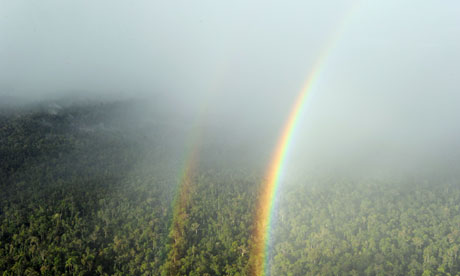
The West Kalimantan province of Borneo, Indonesia. Greenpeace has said it will monitor Golden Agri-Resources to ensure it keeps to its promise. Photograph: Romeo Gacad/AFP/Getty Images
The world's second biggest palm oil company has agreed to halt deforestation in valuable areas of Indonesian forest, bowing to pressure from western food processors and conservationists.
Golden Agri-Resources Limited has committed itself to protecting forests and peatlands with a high level of biodiversity, or which provide major carbon sinks, as part of an agreement with conservation group the Forest Trust.
However, the agreement announced on Wednesday will still leave GAR free to exploit other areas of forest, and land that is judged to be of lower conservation value.
Greenpeace, which has strongly criticised GAR in the past for its alleged destructive activities, is expected to keep a close watch on the company to ensure it lives up to its promises. Bustar Maitar, head of Greenpeace's campaign to protect Indonesian forests, said: "This could be good news for the forests, endangered species like the orangutan and for the Indonesian economy.
"On paper, the new commitments from Golden Agri are a major step towards ending their involvement in deforestation. And if they do make these changes, large areas of forests will be saved. But now they've actually got to implement these plans, and we're watching closely to make sure this happens."
Scott Poynton, executive director of the Forest Trust, a Geneva-based not-for-profit organisation that helps companies improve their environmental sustainability, added: "Today's agreement represents a revolutionary moment in the drive to conserve forests.
"It's about going to the root causes of deforestation – we have shown that the destruction of forests is anchored deeply in the supply chains of the products we consume in industrialised nations, and we are showing we can do something about that."
He said pressure from Nestlé, which last year drew up a set of sustainability guidelines and signalled that it would not accept palm oil from sources connected to deforestation, had been instrumental in bringing GAR to the table.
Franky Wijaya, chief executive of GAR, said: "As a leading player in the palm oil industry, we are committed to playing our role in conserving Indonesia's forests and look forward to working with all stakeholders including the government of Indonesia, other key players in the palm oil industry, NGOs and local communities to find the common ground for sustainable palm oil production.
"Our partnership with the Forest Trust allows us to grow palm oil in ways that conserve forests and that also respond to Indonesia's development needs, creating much needed employment while building shareholder value."
GAR, which has annual revenues of $2.3bn, is the biggest palm oil company in Indonesia – the world's biggest palm oil producing country. The oil is used in an ever-increasing variety of consumer products, from cosmetics to biscuits, generating a market worth $20bn a year. These rewards have driven the clearance of large areas of tropical forest to make way for the plantations.
Under the agreement, GAR will not use areas of forest and peatland that are classified as "high conservation value" or as "high carbon stock", meaning they store large amounts of carbon and should be preserved. However, the definitions of these terms have not yet been precisely set. Poynton said an initial aerial assessment of forest cover had set out "go" and "no-go" areas, with GAR free to exploit the former. The "no-go" areas will be reassessed to find whether they should be regarded as valuable.
Experts in Indonesia will be asked to judge whether GAR forests have "high conservation value" under guidance from the Roundtable on Sustainable Palm Oil, a coalition of the palm oil industry and conservation groups.
The agreement also fell short of setting out how much land GAR may use for new palm planting.
Poynton said that if the agreement was successful, it could help turn Indonesia into a role model for sustainable development. Indonesia has played a strong role in international climate change negotiations, since hosting the Bali conference in 2007.
source http://www.theguardian.com/environment/2011/feb/09/pal-oil-giant-most-valuable-indonesian-rainforest
The West Kalimantan province of Borneo, Indonesia. Greenpeace has said it will monitor Golden Agri-Resources to ensure it keeps to its promise. Photograph: Romeo Gacad/AFP/Getty Images
The world's second biggest palm oil company has agreed to halt deforestation in valuable areas of Indonesian forest, bowing to pressure from western food processors and conservationists.
Golden Agri-Resources Limited has committed itself to protecting forests and peatlands with a high level of biodiversity, or which provide major carbon sinks, as part of an agreement with conservation group the Forest Trust.
However, the agreement announced on Wednesday will still leave GAR free to exploit other areas of forest, and land that is judged to be of lower conservation value.
Greenpeace, which has strongly criticised GAR in the past for its alleged destructive activities, is expected to keep a close watch on the company to ensure it lives up to its promises. Bustar Maitar, head of Greenpeace's campaign to protect Indonesian forests, said: "This could be good news for the forests, endangered species like the orangutan and for the Indonesian economy.
"On paper, the new commitments from Golden Agri are a major step towards ending their involvement in deforestation. And if they do make these changes, large areas of forests will be saved. But now they've actually got to implement these plans, and we're watching closely to make sure this happens."
Scott Poynton, executive director of the Forest Trust, a Geneva-based not-for-profit organisation that helps companies improve their environmental sustainability, added: "Today's agreement represents a revolutionary moment in the drive to conserve forests.
"It's about going to the root causes of deforestation – we have shown that the destruction of forests is anchored deeply in the supply chains of the products we consume in industrialised nations, and we are showing we can do something about that."
He said pressure from Nestlé, which last year drew up a set of sustainability guidelines and signalled that it would not accept palm oil from sources connected to deforestation, had been instrumental in bringing GAR to the table.
Franky Wijaya, chief executive of GAR, said: "As a leading player in the palm oil industry, we are committed to playing our role in conserving Indonesia's forests and look forward to working with all stakeholders including the government of Indonesia, other key players in the palm oil industry, NGOs and local communities to find the common ground for sustainable palm oil production.
"Our partnership with the Forest Trust allows us to grow palm oil in ways that conserve forests and that also respond to Indonesia's development needs, creating much needed employment while building shareholder value."
GAR, which has annual revenues of $2.3bn, is the biggest palm oil company in Indonesia – the world's biggest palm oil producing country. The oil is used in an ever-increasing variety of consumer products, from cosmetics to biscuits, generating a market worth $20bn a year. These rewards have driven the clearance of large areas of tropical forest to make way for the plantations.
Under the agreement, GAR will not use areas of forest and peatland that are classified as "high conservation value" or as "high carbon stock", meaning they store large amounts of carbon and should be preserved. However, the definitions of these terms have not yet been precisely set. Poynton said an initial aerial assessment of forest cover had set out "go" and "no-go" areas, with GAR free to exploit the former. The "no-go" areas will be reassessed to find whether they should be regarded as valuable.
Experts in Indonesia will be asked to judge whether GAR forests have "high conservation value" under guidance from the Roundtable on Sustainable Palm Oil, a coalition of the palm oil industry and conservation groups.
The agreement also fell short of setting out how much land GAR may use for new palm planting.
Poynton said that if the agreement was successful, it could help turn Indonesia into a role model for sustainable development. Indonesia has played a strong role in international climate change negotiations, since hosting the Bali conference in 2007.
European Union funded Comenius Project

Green Skills for Global Change
lunes, 2 de septiembre de 2013
Palm oil giant vows to spare most valuable Indonesian rainforest
source http://www.theguardian.com/environment/2011/feb/09/pal-oil-giant-most-valuable-indonesian-rainforest
The West Kalimantan province of Borneo, Indonesia. Greenpeace has said it will monitor Golden Agri-Resources to ensure it keeps to its promise. Photograph: Romeo Gacad/AFP/Getty Images
The world's second biggest palm oil company has agreed to halt deforestation in valuable areas of Indonesian forest, bowing to pressure from western food processors and conservationists.
Golden Agri-Resources Limited has committed itself to protecting forests and peatlands with a high level of biodiversity, or which provide major carbon sinks, as part of an agreement with conservation group the Forest Trust.
However, the agreement announced on Wednesday will still leave GAR free to exploit other areas of forest, and land that is judged to be of lower conservation value.
Greenpeace, which has strongly criticised GAR in the past for its alleged destructive activities, is expected to keep a close watch on the company to ensure it lives up to its promises. Bustar Maitar, head of Greenpeace's campaign to protect Indonesian forests, said: "This could be good news for the forests, endangered species like the orangutan and for the Indonesian economy.
"On paper, the new commitments from Golden Agri are a major step towards ending their involvement in deforestation. And if they do make these changes, large areas of forests will be saved. But now they've actually got to implement these plans, and we're watching closely to make sure this happens."
Scott Poynton, executive director of the Forest Trust, a Geneva-based not-for-profit organisation that helps companies improve their environmental sustainability, added: "Today's agreement represents a revolutionary moment in the drive to conserve forests.
"It's about going to the root causes of deforestation – we have shown that the destruction of forests is anchored deeply in the supply chains of the products we consume in industrialised nations, and we are showing we can do something about that."
He said pressure from Nestlé, which last year drew up a set of sustainability guidelines and signalled that it would not accept palm oil from sources connected to deforestation, had been instrumental in bringing GAR to the table.
Franky Wijaya, chief executive of GAR, said: "As a leading player in the palm oil industry, we are committed to playing our role in conserving Indonesia's forests and look forward to working with all stakeholders including the government of Indonesia, other key players in the palm oil industry, NGOs and local communities to find the common ground for sustainable palm oil production.
"Our partnership with the Forest Trust allows us to grow palm oil in ways that conserve forests and that also respond to Indonesia's development needs, creating much needed employment while building shareholder value."
GAR, which has annual revenues of $2.3bn, is the biggest palm oil company in Indonesia – the world's biggest palm oil producing country. The oil is used in an ever-increasing variety of consumer products, from cosmetics to biscuits, generating a market worth $20bn a year. These rewards have driven the clearance of large areas of tropical forest to make way for the plantations.
Under the agreement, GAR will not use areas of forest and peatland that are classified as "high conservation value" or as "high carbon stock", meaning they store large amounts of carbon and should be preserved. However, the definitions of these terms have not yet been precisely set. Poynton said an initial aerial assessment of forest cover had set out "go" and "no-go" areas, with GAR free to exploit the former. The "no-go" areas will be reassessed to find whether they should be regarded as valuable.
Experts in Indonesia will be asked to judge whether GAR forests have "high conservation value" under guidance from the Roundtable on Sustainable Palm Oil, a coalition of the palm oil industry and conservation groups.
The agreement also fell short of setting out how much land GAR may use for new palm planting.
Poynton said that if the agreement was successful, it could help turn Indonesia into a role model for sustainable development. Indonesia has played a strong role in international climate change negotiations, since hosting the Bali conference in 2007.

domingo, 1 de septiembre de 2013
polinización: su belleza oculta
Polinización: es vital para la vida en la Tierra, pero en gran medida invisible para el ojo humano. El cineasta Louie Schwartzberg nos muestra el intrincado mundo del polen y los polinizadores con imágenes preciosas de alta velocidad de su película "Alas de la Vida", inspirado en la desaparición de uno de los principales polinizadores de la naturaleza, la abeja.
Louie Schwartzberg is an award-winning cinematographer, director and producer who captures breathtaking images that celebrate life -- revealing connections, universal rhythms, patterns and beauty.
Spanish transcription of the video talk:
Es fantástico estar aquí en TED. Creo que muchas presentaciones me podrían venir a la cabeza, no obstante, los conceptos más asombrosos son los que me pasan exactamente por debajo de los pies. Las pequeñas cosas de la vida, de las que a veces nos olvidamos, y que damos por sentado como la polinización. Y no se puede explicar la historia de los polinizadores - las abejas, murciélagos, colibríes, mariposas - sin contar la historia de la invención de las flores y como fueron coevolucionado durante más de 50 millones de años.
He filmado flores en periodos de 24 horas al día, 7 días a la semana, durante más de 35 años. Para observar su movimiento es un baile del que nunca me cansaré. Esto me llena de asombro y me abre el corazón. La belleza y la seducción, creo, son herramientas de la naturaleza para la supervivencia, porque protegemos aquello de lo que nos enamoramos. Esas relaciones componen una historia de amor que alimenta a la Tierra. Esto nos recuerda que somos una parte de la naturaleza, y no estamos al margen de ella.
Enterarme de la desaparición de las abejas, conocido como problema de colapso de colonias, me llevó a tomar medidas. Dependemos de los polinizadores en el caso de más de un tercio de las frutas y verduras que comemos. Y muchos científicos creen que se trata del problema más grave al que se enfrenta la Humanidad. Es como el canario en la mina de carbón. Si desaparecen, nosotros también. Esto nos recuerda que somos una parte de la naturaleza y tenemos que cuidar de ella.
Lo que me motivó para filmar su comportamiento era algo que pregunté a mis asesores científicos: ¿Qué motiva a los polinizadores? Bueno, su respuesta fue: "Todo gira en torno al riesgo y la recompensa". Como un niño sorprendidísimo dije: "¿Pero por qué es así?" Y dijeron: "Pues, porque quieren sobrevivir". Y proseguí " Pero, ¿por qué?" "Bueno, con el fin de reproducirse". "Ya, pero ¿por qué?" Y pensé que probablemente diría: "Es que todo se mueve en torno al sexo". Y Chip Taylor, nuestro experto en la mariposa monarca, contestó: "Nada es eterno. Todo en el universo llega a agotarse".
Y eso me dejó alucinado. Porque me di cuenta que la naturaleza había inventado la reproducción como mecanismo para la propia vida con el fin de perpetuarse, como una fuerza vital que nos atraviesa y nos convierte en un eslabón más en la evolución de la vida. Rara vez se ve a simple vista, la intersección entre el mundo animal y el mundo vegetal. Es realmente un momento mágico. Es el momento místico donde la vida se regenera, una y otra vez.
Así que aquí les muestro algo de néctar de mi película. Espero que beban, píen y planten algunas semillas para polinizar un jardín agradable. Y siempre tómense tiempo para oler las flores, y déjense impregnar de belleza, y redescubran el sentido de lo maravilloso. Aquí muestro algunas imágenes de la película.
(Música)
(Aplausos)
Gracias. Muchas gracias.
(Aplausos)
Gracias.
sábado, 31 de agosto de 2013

miércoles, 28 de agosto de 2013
Bienvenidos a las ciudades resilientes
¿Qué significa el concepto de resiliencia en cuanto se aplica a una ciudad ?
http://www.unisdr.org/campaign/resilientcities/
 TRANSfORMINg
uNdERSTANdINg
INTO ACTION
ANALySIS
A classic strategic planning analysis
method is the SWOT, referring to
Strengths, Weaknesses (internal),
Opportunities and Threats (external). We
suggest reordering the analysis under
the acronym TWOS, examining issues
before solutions, and prioritizing the
external over the internal as resilience
focuses on preparing for largely external
shocks and stresses; the Threats section
will be informed by the six challenges
of: population, climate change, energy
scarcity, income disparity, socio-political
and environmental degradation. One
should assess all aspects of a city’s
infrastructure: water, energy, waste,
building fabric, etc.
pRObAbILITIES +
IMpACTS vS COST
Quadrant maps can help visualize the
probability of a shock or stress occurring
and its economic impact, mapping these
against the cost of building the capacity
for resilience. This exercise will help
prioritize strategies and tactics.
STRATEgIES +
TACTICS
When creating a series of strategies
and tactics to execute each resilience
approach, the 6 attributes of resilience
should be used to assess the quality of
any given strategy or tactic.
Ask:
> How much flexibility does it allow for?
> How will it facilitate redundancy
in the system?
> How does it support the increase
of diversity in the system?
> How can dependency of systems
be reduced?
> How decentralized is the solution?
> How integrated is the system with
its environmental context?
Strong strategies and/or tactics can
answer many of these questions and can
serve more than one approach, so be
sure to cross-pollinate your worksheets.
SOURCE http://www.resilientcity.org/site/ywd_craigapplegath/assets/pdf/future_proofing_cities_toolkit_by_craig_applegath_2012-03-01sm.pdf
TRANSfORMINg
uNdERSTANdINg
INTO ACTION
ANALySIS
A classic strategic planning analysis
method is the SWOT, referring to
Strengths, Weaknesses (internal),
Opportunities and Threats (external). We
suggest reordering the analysis under
the acronym TWOS, examining issues
before solutions, and prioritizing the
external over the internal as resilience
focuses on preparing for largely external
shocks and stresses; the Threats section
will be informed by the six challenges
of: population, climate change, energy
scarcity, income disparity, socio-political
and environmental degradation. One
should assess all aspects of a city’s
infrastructure: water, energy, waste,
building fabric, etc.
pRObAbILITIES +
IMpACTS vS COST
Quadrant maps can help visualize the
probability of a shock or stress occurring
and its economic impact, mapping these
against the cost of building the capacity
for resilience. This exercise will help
prioritize strategies and tactics.
STRATEgIES +
TACTICS
When creating a series of strategies
and tactics to execute each resilience
approach, the 6 attributes of resilience
should be used to assess the quality of
any given strategy or tactic.
Ask:
> How much flexibility does it allow for?
> How will it facilitate redundancy
in the system?
> How does it support the increase
of diversity in the system?
> How can dependency of systems
be reduced?
> How decentralized is the solution?
> How integrated is the system with
its environmental context?
Strong strategies and/or tactics can
answer many of these questions and can
serve more than one approach, so be
sure to cross-pollinate your worksheets.
SOURCE http://www.resilientcity.org/site/ywd_craigapplegath/assets/pdf/future_proofing_cities_toolkit_by_craig_applegath_2012-03-01sm.pdf
 TRANSfORMINg
uNdERSTANdINg
INTO ACTION
ANALySIS
A classic strategic planning analysis
method is the SWOT, referring to
Strengths, Weaknesses (internal),
Opportunities and Threats (external). We
suggest reordering the analysis under
the acronym TWOS, examining issues
before solutions, and prioritizing the
external over the internal as resilience
focuses on preparing for largely external
shocks and stresses; the Threats section
will be informed by the six challenges
of: population, climate change, energy
scarcity, income disparity, socio-political
and environmental degradation. One
should assess all aspects of a city’s
infrastructure: water, energy, waste,
building fabric, etc.
pRObAbILITIES +
IMpACTS vS COST
Quadrant maps can help visualize the
probability of a shock or stress occurring
and its economic impact, mapping these
against the cost of building the capacity
for resilience. This exercise will help
prioritize strategies and tactics.
STRATEgIES +
TACTICS
When creating a series of strategies
and tactics to execute each resilience
approach, the 6 attributes of resilience
should be used to assess the quality of
any given strategy or tactic.
Ask:
> How much flexibility does it allow for?
> How will it facilitate redundancy
in the system?
> How does it support the increase
of diversity in the system?
> How can dependency of systems
be reduced?
> How decentralized is the solution?
> How integrated is the system with
its environmental context?
Strong strategies and/or tactics can
answer many of these questions and can
serve more than one approach, so be
sure to cross-pollinate your worksheets.
SOURCE http://www.resilientcity.org/site/ywd_craigapplegath/assets/pdf/future_proofing_cities_toolkit_by_craig_applegath_2012-03-01sm.pdf
TRANSfORMINg
uNdERSTANdINg
INTO ACTION
ANALySIS
A classic strategic planning analysis
method is the SWOT, referring to
Strengths, Weaknesses (internal),
Opportunities and Threats (external). We
suggest reordering the analysis under
the acronym TWOS, examining issues
before solutions, and prioritizing the
external over the internal as resilience
focuses on preparing for largely external
shocks and stresses; the Threats section
will be informed by the six challenges
of: population, climate change, energy
scarcity, income disparity, socio-political
and environmental degradation. One
should assess all aspects of a city’s
infrastructure: water, energy, waste,
building fabric, etc.
pRObAbILITIES +
IMpACTS vS COST
Quadrant maps can help visualize the
probability of a shock or stress occurring
and its economic impact, mapping these
against the cost of building the capacity
for resilience. This exercise will help
prioritize strategies and tactics.
STRATEgIES +
TACTICS
When creating a series of strategies
and tactics to execute each resilience
approach, the 6 attributes of resilience
should be used to assess the quality of
any given strategy or tactic.
Ask:
> How much flexibility does it allow for?
> How will it facilitate redundancy
in the system?
> How does it support the increase
of diversity in the system?
> How can dependency of systems
be reduced?
> How decentralized is the solution?
> How integrated is the system with
its environmental context?
Strong strategies and/or tactics can
answer many of these questions and can
serve more than one approach, so be
sure to cross-pollinate your worksheets.
SOURCE http://www.resilientcity.org/site/ywd_craigapplegath/assets/pdf/future_proofing_cities_toolkit_by_craig_applegath_2012-03-01sm.pdf
Suscribirse a:
Entradas (Atom)